Introduction
Banks and financial institutions process enormous amounts of sensitive information every day. From ACH payment files and wire transfers to customer account records and treasury reports, financial data moves constantly between internal systems, vendors, clearinghouses, and business partners.
As cyber threats continue to rise, protecting this information has become one of the most important responsibilities in the banking industry. A single data breach or unauthorized file transfer can result in financial loss, regulatory penalties, reputational damage, and loss of customer trust.
This is why file encryption has become a critical security requirement for banks and financial organizations.
What Is File Encryption?
File encryption is the process of converting readable data into an unreadable format using cryptographic algorithms. Only authorized users or systems with the correct decryption key can access the original information.
Encryption protects sensitive files while they are:
- Stored on servers
- Sent across networks
- Shared with third parties
- Archived for compliance purposes
- Backed up for disaster recovery
Even if attackers intercept encrypted files, they cannot read the data without the proper encryption keys.
For banks, encryption is one of the most effective ways to secure financial information and reduce cybersecurity risk.
Why File Encryption Is Essential for Banks
Banks handle highly sensitive information including:
- Customer account data
- ACH payment files
- Wire transfer records
- Payroll files
- Tax documents
- Treasury reports
- Loan information
- Credit card data
- Financial statements
Cybercriminals actively target financial institutions because of the value of this information.
Without encryption, sensitive files can be exposed during:
- Email transfers
- FTP uploads
- Vendor exchanges
- Cloud storage
- Internal file sharing
- Remote access sessions
Encryption ensures that confidential financial data remains protected even if systems are compromised.
Common Threats Facing Financial Institutions
1. Data Breaches
Hackers frequently target banks using:
- Malware
- Ransomware
- Phishing attacks
- Credential theft
- Insider threats
If sensitive files are not encrypted, attackers may gain direct access to confidential customer or financial information.
2. Man-in-the-Middle Attacks
Unsecured file transfers can be intercepted while data is moving across networks.
Traditional FTP transfers are especially vulnerable because they transmit data in plain text.
Encrypted file transfer protocols such as SFTP combined with PGP encryption help prevent interception and unauthorized access.
3. Insider Threats
Not all security risks come from outside attackers.
Employees, contractors, or vendors with excessive access may accidentally or intentionally expose sensitive data.
Encryption adds another layer of protection by limiting who can access file contents.
4. Regulatory Violations
Banks must comply with strict financial security regulations. Failure to secure customer information can lead to:
- Heavy fines
- Compliance violations
- Legal actions
- Audit findings
- Loss of customer trust
Encryption helps organizations meet regulatory requirements and improve audit readiness.
Types of File Encryption Used by Banks
PGP Encryption
PGP (Pretty Good Privacy) is one of the most commonly used encryption methods in the banking industry.
PGP encryption:
- Encrypts files before transmission
- Uses public and private key pairs
- Ensures only authorized recipients can decrypt files
- Supports digital signatures for authentication
Banks commonly use PGP for:
- ACH file transfers
- Treasury files
- Payment processing
- Vendor exchanges
- Financial reporting
Full Disk Encryption
Banks also use full disk encryption to protect:
- Servers
- Workstations
- Laptops
- Backup devices
This helps secure stored data if devices are lost or stolen.
Transport Encryption
Transport encryption protects files while they move across networks.
Common secure transfer methods include:
- SFTP (Secure File Transfer Protocol)
- FTPS
- HTTPS APIs
- VPN tunnels
SFTP is widely preferred because it provides encrypted file transfer over SSH connections.
How SFTP and Encryption Work Together
Many financial organizations combine:
- SFTP for secure transmission
- PGP for file-level encryption
This creates multiple layers of protection.
For example:
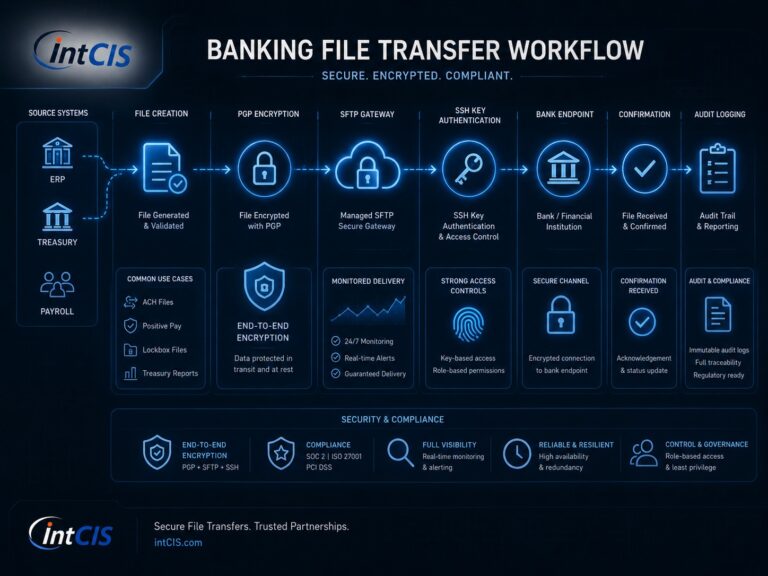
- A payroll or ACH file is generated
- The file is encrypted using PGP
- The encrypted file is transferred using SFTP
- The receiving bank decrypts the file securely
Even if attackers intercept the transfer, the file remains unreadable.
This layered security approach is considered a best practice in the financial industry.
Benefits of File Encryption for Banks
1. Protection of Sensitive Financial Data
Encryption helps protect:
- Customer information
- Banking transactions
- Internal financial records
- Payment files
This reduces the risk of unauthorized disclosure.
2. Regulatory Compliance
Encryption supports compliance with:
- GLBA (Gramm-Leach-Bliley Act)
- PCI-DSS
- SOX
- FFIEC guidelines
- NACHA requirements
Many financial regulations either recommend or require encryption for sensitive data.
3. Reduced Cybersecurity Risk
Encrypted files are significantly harder for attackers to exploit.
Even if systems are breached, encrypted data remains protected.
4. Improved Customer Trust
Customers expect banks to protect their personal and financial information.
Strong encryption practices demonstrate a commitment to cybersecurity and data privacy.
5. Secure Vendor and Partner Communication
Banks frequently exchange files with:
- Payment processors
- Vendors
- Government agencies
- Clearinghouses
- Auditors
Encryption helps ensure third-party communications remain secure.
Best Practices for Banking File Encryption
Use Strong Encryption Standards
Banks should use modern encryption algorithms such as:
- AES-256
- RSA
- OpenPGP standards
Weak or outdated encryption methods should be avoided.
Implement SSH Key Authentication
Password-based authentication is less secure.
SSH keys provide stronger protection for SFTP access.
Rotate Encryption Keys Regularly
Encryption keys should be rotated periodically to reduce long-term risk.
Monitor File Transfers
Banks should maintain:
- Audit logs
- Transfer history
- Access monitoring
- Security alerts
This improves visibility and compliance reporting.
Automate Encryption Workflows
Automation reduces human error and ensures files are consistently encrypted before transmission.
Automated workflows can include:
- Scheduled encryption
- Secure uploads
- Notifications
- Error handling
Maintain Disaster Recovery Plans
Encrypted backup files should be included in disaster recovery planning to support business continuity.
Why Managed Encryption Services Are Growing
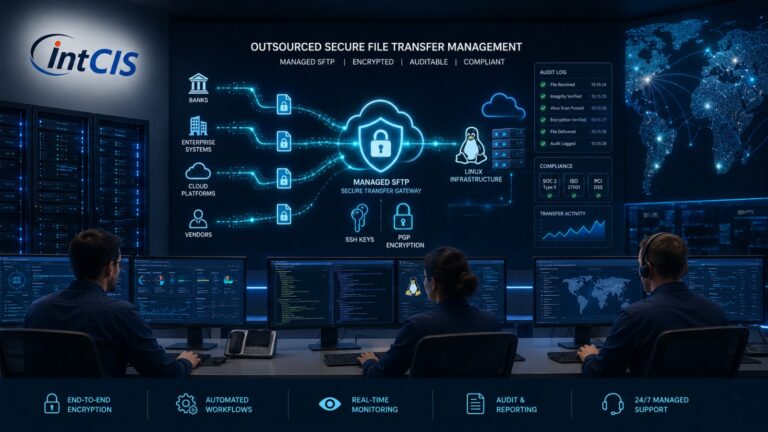
Many banks are moving toward managed secure file transfer and encryption services because they:
- Reduce operational burden
- Improve security
- Provide 24×7 monitoring
- Support compliance audits
- Simplify vendor integrations
- Offer scalable infrastructure
Managed providers often specialize in:
- SFTP automation
- PGP encryption
- ACH file security
- Audit logging
- Secure cloud integrations
This allows banks to focus on core financial operations while security experts manage file transfer infrastructure.
Final Thoughts
File encryption is no longer optional for banks and financial institutions. It is a critical component of modern cybersecurity strategy.
As cyberattacks become more sophisticated, financial organizations must protect sensitive data both in transit and at rest. Combining strong encryption with secure file transfer solutions such as SFTP helps banks reduce risk, support compliance, and maintain customer trust.
Whether handling ACH files, payment processing, treasury operations, or vendor exchanges, encryption provides the security foundation needed to protect today’s financial systems.
Banks that invest in secure encrypted file transfer solutions are better prepared to meet regulatory requirements, defend against cyber threats, and support long-term operational resilience.