Introduction
Organizations across banking, healthcare, government, payroll, and enterprise environments exchange sensitive files every day. ACH transactions, treasury reports, payroll files, healthcare records, vendor data, and financial documents are routinely transferred between systems, cloud platforms, vendors, and banking institutions.
As cyber threats continue to evolve, secure file transfer has become a critical business and cybersecurity requirement.
Unfortunately, many organizations still make serious mistakes when implementing PGP encryption and secure file transfer workflows. Misconfigured encryption environments, poor key management, insecure automation, and outdated FTP systems can create major operational and compliance risks.
Cybercriminals increasingly target:
- file transfer systems
- banking integrations
- vendor workflows
- treasury operations
- healthcare data exchange
- payroll environments
A single encryption failure or insecure transfer can lead to:
- data breaches
- ransomware exposure
- financial fraud
- compliance violations
- operational disruption
- reputational damage
To reduce these risks, organizations must combine:
- PGP encryption
- Secure SFTP
- SSH encryption
- enterprise Linux hardening
- automation
- audit logging
- managed file transfer solutions
Understanding common PGP encryption mistakes is critical for improving cybersecurity posture and operational reliability.
What Are Common PGP Encryption Mistakes Businesses Make?
PGP (Pretty Good Privacy) encryption is widely used to secure sensitive business files during transmission and storage.
However, implementing encryption alone is not enough.
In many environments, organizations make operational and security mistakes that weaken the effectiveness of their encryption strategy.
Common mistakes include:
- using insecure FTP
- poor key management
- weak automation practices
- failing to rotate encryption keys
- inadequate monitoring
- weak access controls
- missing audit visibility
These mistakes can expose sensitive files even when encryption technologies are technically present.
Technical Overview
PGP encryption uses:
- public/private key cryptography
- strong encryption algorithms
- digital signatures
- integrity validation
Secure workflows typically include:
- File generation
- PGP encryption
- Secure SFTP transfer
- Validation and logging
- Secure decryption
Weaknesses at any stage can introduce security and compliance risks.
Why Businesses Need Proper PGP Encryption Practices
Security Benefits
Strong encryption workflows protect:
- ACH files
- payroll data
- healthcare records
- treasury reports
- vendor files
- customer information
Proper implementation reduces exposure to:
- interception
- unauthorized access
- insider threats
- ransomware attacks
Compliance Benefits
Financial and healthcare organizations must comply with:
- HIPAA
- PCI-DSS
- SOC 2
- GDPR
- NACHA
- FFIEC
Improper encryption practices may result in:
- audit findings
- regulatory penalties
- compliance violations
Operational Benefits
Well-designed encryption workflows improve:
- reliability
- automation
- transfer consistency
- operational efficiency
Automation reduces manual operational errors.
Scalability Advantages
Modern organizations exchange files across:
- hybrid cloud environments
- enterprise Linux systems
- banking integrations
- containerized platforms
- vendor ecosystems
Secure automation supports scalable enterprise workflows.
Common Risks Without Secure SFTP
FTP Vulnerabilities
One of the most common mistakes businesses make is continuing to use traditional FTP.
FTP transmits:
- usernames
- passwords
- file contents
in plain text.
Attackers can easily intercept FTP traffic using:
- packet sniffing
- credential harvesting
- network interception
FTP should never be used for sensitive business workflows.
Data Breaches
Improper encryption workflows may expose:
- payroll information
- ACH transactions
- treasury reports
- healthcare records
- financial data
A breach can lead to:
- financial loss
- reputational damage
- legal consequences
- operational disruption
Ransomware Risks
Weakly secured file transfer environments are common ransomware targets.
Poorly managed automation systems, exposed servers, and unpatched Linux environments increase risk exposure.
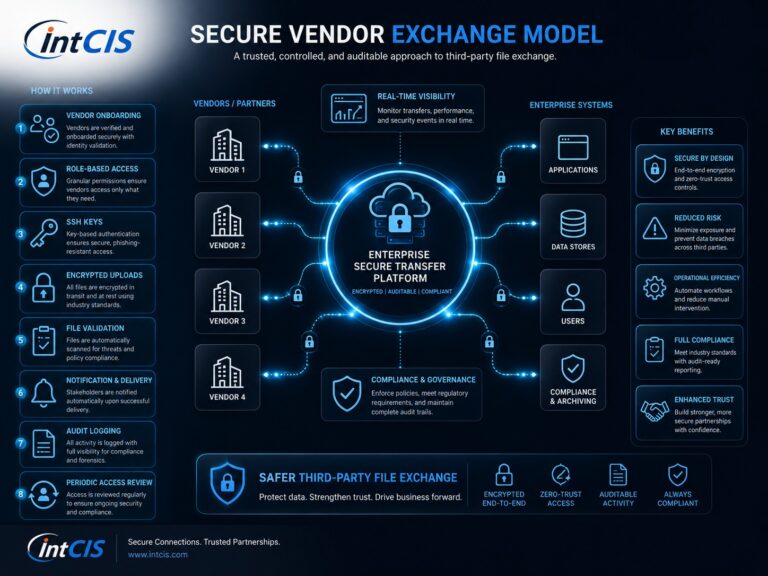
Vendor and Third-Party Risks
Organizations frequently exchange files with:
- banks
- suppliers
- payroll providers
- healthcare vendors
- cloud platforms
Weak third-party encryption practices can compromise entire workflows.
Insider Threats
Improper access controls and poor key management can expose sensitive data internally.
Encryption alone does not eliminate insider risk.
Compliance Failures
Missing logs, weak controls, and poor monitoring often result in:
- audit deficiencies
- compliance failures
- regulatory scrutiny
Key Features and Technologies
Secure SFTP
SFTP (SSH File Transfer Protocol) provides encrypted communication channels for secure file exchange.
Benefits include:
- encrypted sessions
- integrity protection
- secure authentication
- automation support
SSH Encryption
SSH protects:
- file transfers
- remote administration
- automation workflows
- command execution
PGP Encryption
PGP provides file-level encryption protection even after transfer completion.
SSH Keys
SSH keys improve security by reducing password exposure.
Benefits:
- secure automation
- stronger authentication
- reduced brute-force risk
Multi-Factor Authentication (MFA)
MFA adds additional protection through:
- tokens
- authentication apps
- biometric verification
Audit Logging
Logging supports:
- compliance
- investigations
- operational monitoring
- transfer visibility
Automation
Automation tools commonly include:
- shell scripting
- cron jobs
- Ansible
- enterprise schedulers
- APIs
Proper automation reduces human error.
Secure APIs
Modern systems integrate using secure APIs for:
- ERP systems
- treasury platforms
- cloud services
- banking applications
High Availability
Business-critical transfer systems require:
- redundancy
- failover
- monitoring
- clustering
Disaster Recovery
Organizations should maintain:
- encrypted backups
- replication
- failover testing
- recovery automation
Common PGP Encryption Mistakes Businesses Make
1. Using FTP Instead of Secure SFTP
This remains one of the biggest security mistakes.
FTP lacks encryption and exposes credentials and files.
Always replace FTP with Secure SFTP.
2. Poor Encryption Key Management
Many organizations:
- store keys insecurely
- share keys improperly
- fail to protect private keys
Private keys should:
- remain confidential
- be access-controlled
- be rotated regularly
3. Failing to Rotate Encryption Keys
Long-term use of the same keys increases exposure risk.
Best practice:
- rotate keys periodically
- revoke unused keys
- maintain expiration policies
4. Weak Linux Server Security
Encryption is ineffective if underlying systems are insecure.
Common Linux mistakes include:
- missing patches
- weak permissions
- exposed SSH access
- poor firewall configuration
5. Missing Audit Logging
Many organizations lack proper visibility into:
- transfer activity
- encryption operations
- failed transfers
- unauthorized access
Comprehensive logging is critical.
6. Insecure Automation Scripts
Poorly designed scripts may:
- expose passwords
- mishandle files
- skip validation
- fail silently
Automation workflows should include:
- error handling
- validation
- monitoring
- secure credential handling
7. Lack of Multi-Factor Authentication
Administrative systems protected only by passwords remain vulnerable.
MFA should be enabled wherever possible.
8. Improper Vendor Security Validation
Organizations often trust vendors without validating:
- encryption practices
- file transfer security
- access controls
Third-party security reviews are important.
9. Failure to Test Disaster Recovery
Many organizations encrypt data but fail to validate:
- backup recovery
- key restoration
- failover workflows
DR testing is essential.
10. Treating Encryption as the Only Security Control
Encryption alone is not enough.
Organizations also need:
- monitoring
- hardening
- automation security
- access control
- incident response
Final Thoughts
PGP encryption remains one of the most important technologies for protecting sensitive business files. However, many organizations weaken their security posture through poor implementation practices, weak automation, improper key management, and insecure transfer methods.
By understanding and avoiding common PGP encryption mistakes, businesses can significantly improve:
- cybersecurity resilience
- operational reliability
- compliance readiness
- secure file transfer operations
When combined with Secure SFTP, enterprise Linux hardening, automation, and managed infrastructure services, strong encryption workflows help organizations securely support modern enterprise operations.